Revagenix’s Rev-56 Enters Phase 1: Why Bronchiectasis Evidence Strategy Must Start Before Efficacy Data
Revagenix’s Rev-56 Enters Phase 1: Why Bronchiectasis Evidence Strategy Must Start Before Efficacy Data
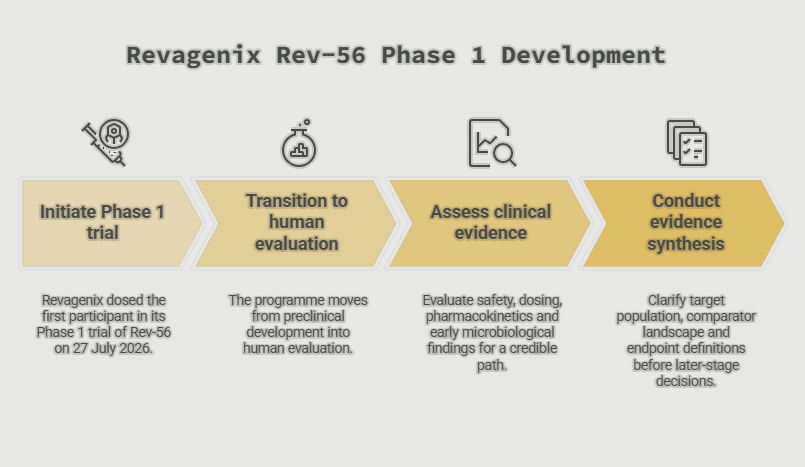
Revagenix announced on 27 July 2026 that the first participant had been dosed in its Phase 1 trial of Rev-56, an inhaled anti-pseudomonal candidate for non-cystic-fibrosis bronchiectasis, or NCFB [1]. The milestone moves the programme from preclinical development into human evaluation, but it also changes the evidence question. The immediate priority is no longer whether the biological rationale is interesting. It is whether safety, dosing, pharmacokinetics and early microbiological findings can support a credible path towards clinically meaningful outcomes.
That distinction matters for clinical development, regulatory communication and future market access. Evidence synthesis conducted now can clarify the target population, comparator landscape and endpoint definitions before later-stage decisions become expensive to revise.
What the Phase 1 milestone establishes
The registered Phase 1a/1b study evaluates inhaled Rev-56 against placebo in healthy adults and subsequently in adults with NCFB and Pseudomonas aeruginosa infection. Part A focuses on single-dose safety, tolerability and pharmacokinetics in healthy participants. Part B is expected to extend the assessment to patients and include initial microbiological or pharmacodynamic measures [1,2]. Revagenix has stated that topline Part A data are expected by the end of 2026, although this remains a prospective company timeline rather than a completed result.
First-participant dosing therefore confirms operational and clinical-development progress. It does not yet establish efficacy, an optimal dose, sustained bacterial suppression or an effect on exacerbations and hospitalisations.
The treatment landscape is not an empty field
The current NCFB landscape needs to be described carefully. In August 2025, the US Food and Drug Administration approved brensocatib for NCFB in patients aged 12 years and older [3]. Any contemporary evidence review should therefore avoid the outdated statement that bronchiectasis has no approved therapy. Brensocatib, however, addresses neutrophilic inflammation rather than serving as a pathogen-specific anti-pseudomonal treatment.
For patients with chronic P. aeruginosa infection and a high risk of exacerbations, the 2025 European Respiratory Society guideline strongly recommends long-term inhaled antibiotics despite standard care, based on moderate-certainty evidence [4]. The guideline’s evidence synthesis found that inhaled antibiotics reduced exacerbation frequency overall, while also identifying antimicrobial resistance, tolerability, treatment burden and variable patient response as continuing concerns.
Rev-56 will consequently enter an evidence environment containing approved anti-inflammatory treatment, guideline-supported inhaled antibiotics, macrolides, airway-clearance interventions and other supportive care. Comparator selection cannot be reduced to “active treatment versus no treatment.”
A living evidence map should precede later-stage design
A focused systematic literature review can establish how chronic P. aeruginosa infection has been defined, which patient characteristics predict exacerbations, and how previous inhaled-antibiotic studies handled background treatment, dosing schedules and delivery devices.
It should also map resistance outcomes, bacterial-density measures, culture conversion, adherence and treatment discontinuation. A network meta-analysis may eventually be useful, but its feasibility should first be tested against differences in populations, endpoint definitions, treatment duration and trial design.
The evidence plan is like laying railway track ahead of a moving train. It must provide enough structure to prevent the programme from drifting, without pretending that the final destination is known before early clinical data arrive. A living review, updated at predefined milestones, is more useful than a one-off literature summary that becomes obsolete before a Phase 2 protocol is finalised.
Endpoint selection must connect biology with patient value
Safety, tolerability and pharmacokinetics are appropriate early-phase priorities. Later development will need to connect antimicrobial activity with outcomes that matter to patients, clinicians and decision-makers.
These may include sputum bacterial density, culture status, exacerbation frequency, time to first exacerbation, severe exacerbations, hospitalisation, rescue-antibiotic use, respiratory symptoms, quality of life, lung function and antimicrobial resistance. Bronchiectasis trials have historically used heterogeneous endpoints and definitions, complicating comparisons and contributing to uncertainty when otherwise plausible interventions are evaluated [5].
An endpoint map should therefore record the clinical meaning, measurement schedule, recall period, estimand, missing-data approach and evidence of responsiveness for each candidate outcome. This work can inform protocol development while also creating consistent language for regulatory documents and publications.
Medical writing provides continuity across the programme
Medical writing at this stage is not simply preparation of a future manuscript. It provides a traceable narrative linking disease biology, nonclinical findings, dose rationale, trial objectives and emerging results.
Protocol-related documents, investigator materials, clinical summaries, safety narratives, congress abstracts and manuscripts should use consistent definitions and appropriately qualified claims. Terms such as “first-in-class,” “targeted” or “potentially once daily” should be clearly attributed to the sponsor until comparative or clinical evidence substantiates them.
This discipline reduces the risk of the scientific story changing between documents or moving beyond what the data support.
Economic modelling should be sequenced, not rushed
A full cost-effectiveness or budget-impact model would be premature before dose selection and clinical-effect estimates become available. Nevertheless, early value planning can identify the data that later models will require.
A conceptual framework could map the chronic P. aeruginosa patient journey, exacerbations, hospital admissions, antibiotic use, monitoring, device and administration burden, resistance-related treatment changes and health-related quality of life. Real-world evidence feasibility work can then assess whether these variables are observable in claims, electronic health records, registries or prospective studies.
When efficacy and duration-of-effect evidence mature, this framework can develop into a cost-utility model, budget-impact analysis, Markov model or patient-level microsimulation rather than beginning from an empty spreadsheet.
Building an evidence pathway around Rev-56
For programmes such as Rev-56, Epi Fractals can support a living SLR, meta-analysis or NMA feasibility assessment, GRADE evaluation, comparator and endpoint mapping, protocol-related medical writing and publication planning. Later requirements may include patient-journey research, epidemiology, RWE studies, economic modelling and transparent R-Shiny decision tools [6].
The objective is not to predict a successful clinical result. It is to ensure that each emerging result can be interpreted against the right evidence base and translated transparently into the next development decision.
To discuss a bronchiectasis evidence review, endpoint strategy, medical-writing programme or future HEOR requirement, contact Epi Fractals.
References
[1] Revagenix, Inc. 2026. Revagenix Doses First Participant in Phase 1 Trial of Rev-56, an Inhaled Therapy for Non-CF Bronchiectasis. GlobeNewswire.
[2] US National Library of Medicine. 2026. A Phase 1a/1b Study to Investigate the Safety, Tolerability, Microbiological Response, and Pharmacokinetics of Inhaled Rev-56. ClinicalTrials.gov. NCT07709494.
[3] US Food and Drug Administration. 2025. BRINSUPRI (brensocatib) Prescribing Information. FDA.
[4] Chalmers JD, Aliberti S, et al. 2025. European Respiratory Society Clinical Practice Guideline for the Management of Adult Bronchiectasis. European Respiratory Journal. 66(6):2501126. DOI: 10.1183/13993003.01126-2025
[5] Crichton ML, Aliberti S, Chalmers JD. 2019. A Systematic Review of Pharmacotherapeutic Clinical Trial End-Points for Bronchiectasis in Adults. European Respiratory Review. 28(151):180108. DOI: 10.1183/16000617.0108-2018
[6] Epi Fractals. 2026. Real-World Evidence, HEOR, Evidence Synthesis and Medical-Writing Capabilities. Epi Fractals.